
What Are Google AI Overviews and Why Are They Killing Your Local Traffic?
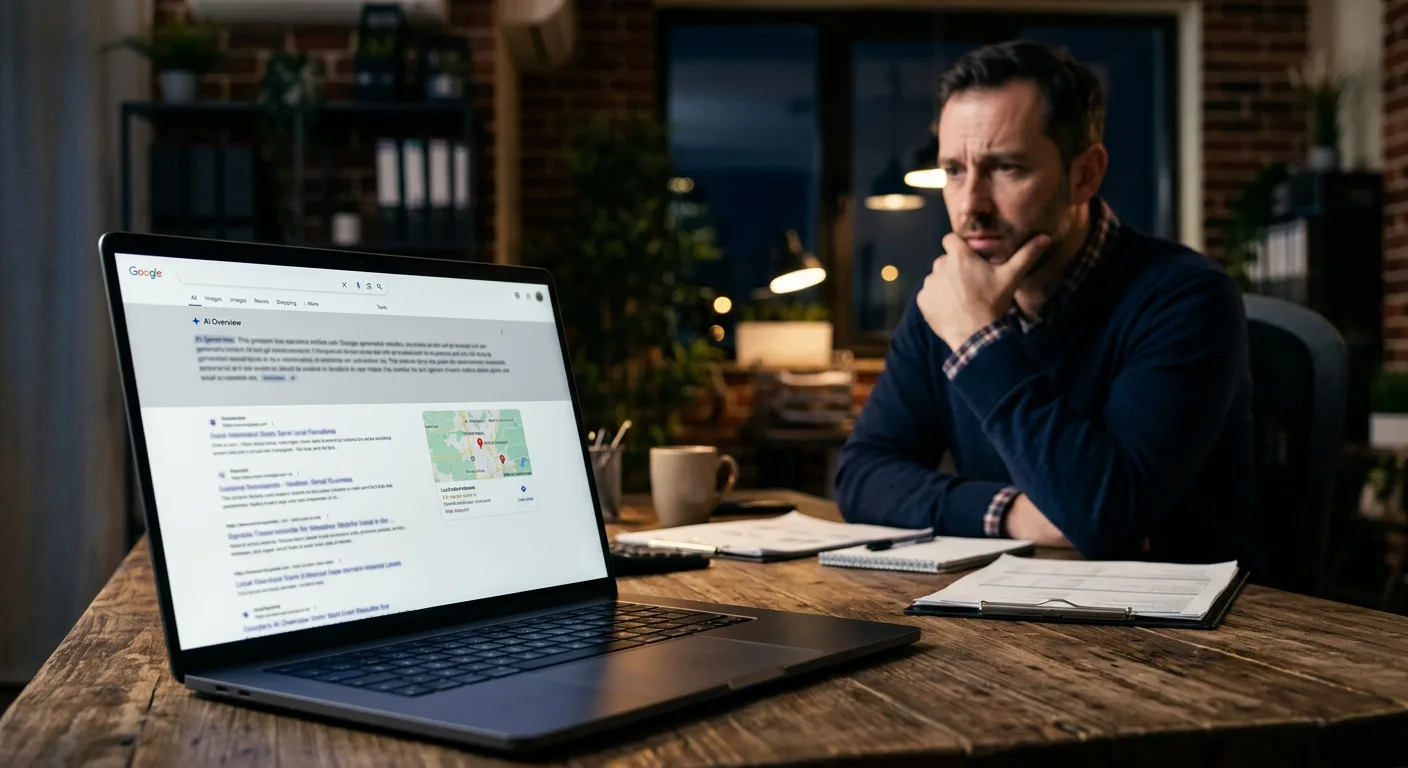
Six months ago Google started injecting AI Overviews into local SERPs. What used to be a block of 3–5 blue links is now a grey summary box that answers the user’s question directly and cites three competitors. The result: you lose clicks.
Makler and Handwerker who build their lead generation on local SEO are the hardest hit. When someone searches “estate agent in Hannover” or “emergency electrician Berlin”, Google now shows the complete answer without requiring a click — but does cite three businesses (often your competitors) inside the block. According to our client data, organic traffic from local searches is falling between 15% and 25%.
Concrete Data: How Much Traffic AI Overviews Are Costing You
I reviewed analytics for 12 local business clients in Germany over the past three months. The numbers:
- Immediate-result local searches (e.g. “price per m² houses Berlin”): 22% less traffic
- Urgent service searches (e.g. “24h plumber”): 18% decline
- Direction or contact searches (e.g. “address of office X”): 35% decline — the most severe
Not every query triggers an AI Overview. Long transactional queries (“how to choose a Makler to sell a house”) still send traffic. The dangerous ones are short and hyper-local.
The upside: if you get cited inside an AI Overview, the clicks you receive are extremely high intent. Someone who clicks your name inside the overview is specifically looking for you, not browsing.
Tactic #1: Dominate the Local Knowledge Graph (Your #1 Defence)
Google prioritises the Knowledge Graph to determine which businesses appear in local AI Overviews. If your business is in the Knowledge Graph, you have a 3× higher chance of being cited.
How to build your Knowledge Graph presence:
Step 1: Claim and fully optimise Google Business Profile Your GBP is the source of truth for the Knowledge Graph. Make sure it is 100% complete: exact business name, address, phone number, clear primary category, opening hours, and high-quality photos.
Step 2: Structured schema markup on your site Add schema.org/LocalBusiness or schema.org/RealEstateAgent to your homepage. Google needs to read authoritative code from your domain.
Step 3: Authority mentions (local backlinks) Google favours businesses cited on high-authority local sites: chambers of commerce, regional directories, local media. Invest time in earning citations on those sites.
Expected result: Within 4–6 weeks your business should appear in local Knowledge Graph searches. From there you are a candidate for AI Overview citations.
Tactic #2: Optimise Your GBP for AI Overview Citation
Once you’re in the Knowledge Graph, the second filter Google applies is: Is this business trustworthy and active?
This is measured by:
- Number and quality of reviews (4.5+ stars is the benchmark; at 4.2 you lose points)
- Owner responses to negative reviews (Google checks whether you respond, not just the content)
- Regular GBP posts (updates, offers, events)
- Message response speed in GBP
Each of these signals influences whether Google cites you in the AI Overview. The correlation is clear.
Concrete action: Create a 30-minute weekly workflow to respond to reviews and publish a post on GBP. This is not “nice content marketing” — it’s trust maintenance.
How to Automate Positive Reviews With Claude API (No Spam, Full Transparency)
This is where Claude comes in. Many agencies run “fake reviews” or buy reputation. That is dangerous (Google penalises it, and it is illegal in many jurisdictions).
What you can do: automate invitations to satisfied clients to leave reviews.
Example workflow:
-
Trigger automatically after a successful sale or closing: “Hi John, your transaction was completed. Would you give us 2 minutes to leave a Google review?” (SMS or email)
-
Use Claude to personalise the message by client type and outcome:
- Client who sold quickly: “You sold your property in 20 days — 40% faster than the local average.”
- Client who bought without issues: “You completed your purchase without complications. Share your experience.”
-
Claude generates variations so it does not look like a template (avoids Google spam detection):
- Var 1: “2 minutes to help us grow”
- Var 2: “Leave your honest Google review”
- Var 3: “Your feedback is valuable to clients like you”
-
Monitor: After 48 hours, if the client has not left a review, send one follow-up reminder — once only.
Result: Real clients leaving real reviews. Google sees legitimate citation activity. Your GBP rises from 4.0 to 4.4 stars. The AI Overview starts citing you.
The numbers game: 100 invitations → 15–20 new reviews (typical conversion rate). 20 high-quality reviews = measurable trust signal.
Checklist: 7 Steps to Protect Your Local Traffic in 2026
- Complete your Knowledge Graph: GBP 100%, schema markup, local citations (Week 1–2)
- Structure your GBP for citation: Reviews 4.5+, respond to negatives, post weekly (Week 2 onwards)
- Automate review invitations with Claude API: 50–100 invitations per month (Week 3)
- Monitor AI Overview citations: Search your local keyword every 2 weeks (Week 2 onwards)
- Compete for local backlinks: Reach out to chambers, directories, local media (Month 1–2)
- Maintain fast response speed: GBP, reviews, direct messages <24h (Month 1 onwards)
- Iterate and measure: Weeks 1, 4, 8, 12 — review changes in ranking and AI Overview citations (Continuous)
FAQ: AI Overviews and Local SEO
Are AI Overviews permanent or will Google remove them?
Google has stated they are here to stay. The format will evolve — features are added and removed each month. The strategy of defending your Knowledge Graph and GBP is future-proof.
If I appear in the AI Overview do I lose clicks?
The opposite: clicks you receive are very high intent. Someone who clicks your name inside the overview is actively seeking you out. Better 10 qualified clicks than 30 navigational ones.
How long does it take to appear in the AI Overview after optimising?
Typical timeline: 2–3 weeks if your GBP and Knowledge Graph are already in good shape. 6–8 weeks from scratch. It also depends on local competition.
Does this work for Handwerker too, not just Makler?
It works equally for plumbers, electricians, and carpenters. The pattern is identical: Knowledge Graph → GBP trustworthiness → AI Overview citation. The only differences are the schema markup and local keywords.
Is local SEO still worth investing in if Google is showing AI Overviews?
Absolutely. AI Overviews draw users into search, but the final click is yours if you optimise correctly. It is like saying “search engines aren’t worth it because of paid ads”. AI Overviews are the new format, not the death of local SEO.
Free Audit at nestorsegura.com/audit
This shift in how Google ranks locally is affecting all Makler, Handwerker, and Dienstleister simultaneously. Act now and you move ahead of 80% of competitors who are still waiting.
Request a free audit at nestorsegura.com/audit. Within 48 hours I will send you a report covering:
- Current state of your Knowledge Graph (present yes/no, completeness)
- Health score of your Google Business Profile
- AI Overview position for your 10 main local keywords
- Personalised checklist of the 3 most urgent steps for your situation
This is diagnosis, not a sales pitch. Many clients implement just Step 1 (GBP optimisation) and already see new traffic. Some notice the change in 3 weeks.
I’ll see you at the audit.
Automate Your GBP in 20 Min — Prompts + Step-by-Step
Enter your email and I'll send you the guide estate agents and tradespeople use to automate their Google Business Profile in 20 minutes.
Check your inbox — the guide is on its way.
No spam · Unsubscribe anytime